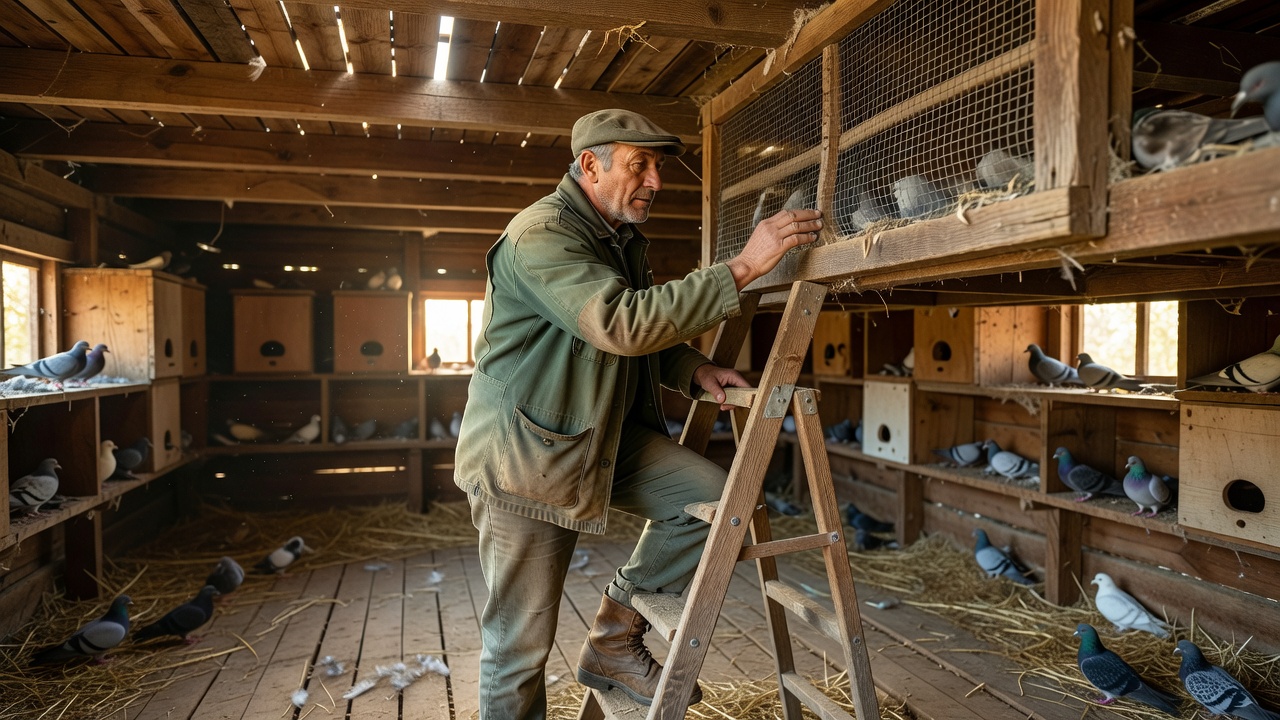
Ventilation should remove moisture and stale air while keeping resting birds out of direct, concentrated gusts. Start by finding where air enters, where it leaves and what stands between.
Think in routes, not isolated holes
An opening does not guarantee useful air exchange. Nearby obstacles, wind direction, temperature differences and blocked screens all influence the route. A pair of vents close together may exchange air mainly between themselves while leaving the rest of the loft poorly served.
Protected replacement air
→
Gentle distribution through loft
→
High-level discharge
Concept diagram only. Wind can alter or reverse flows; opening positions and sizes require site-specific assessment.
Understand what the air needs to carry away
Birds, drinking water, droppings and cleaning all contribute moisture. Damp surfaces and persistent condensation can signal that moisture is not leaving effectively, but the source may also be a roof leak, wet ground or spilled water. Inspect the whole building before deciding that a larger vent will solve everything.
Dust and irritating gases also matter. A strong stale or ammonia-like smell warrants immediate investigation of hygiene, moisture and ventilation, yet absence of smell does not prove good air quality. People can become accustomed to odours. Monitor the birds and surfaces as well as your own impression when entering, and obtain veterinary advice for signs of illness rather than relying on building changes alone.
Protect inlets without sealing them away
Locate replacement-air openings so wind-driven rain is excluded and incoming air is not aimed straight at occupied perches or nesting compartments. A carefully designed baffle can redirect a concentrated stream, but it must leave an adequate, cleanable passage. An improvised board placed tightly over a vent can simply stop the supply.
Provide access to any mesh, grille or insect screen because accumulated dust reduces its effective free area. Manufacturer dimensions may describe the overall grille rather than the open area air can actually pass through. Consider weather protection, predator resistance and maintenance together; solving one problem by making another inaccessible is rarely a lasting improvement.
Keep vent inspection within safe reach. Do not stand on unstable furniture or disturb dusty screens over occupied nest areas.
Give moist air a dependable exit
Higher outlets can help warmer, moisture-laden air escape when conditions support that movement. Their performance still depends on a replacement-air supply and the pressure around the building. A high opening hidden in a stagnant roof pocket may do less than expected, especially if partitions block the route from occupied sections.
Keep rain protection and roof detailing separate from accidental gaps. Uncontrolled leakage is difficult to adjust, may admit water and cannot be relied on as a designed ventilation system. Ask a competent ventilation or building professional to assess awkward sites, complex compartments or persistent problems. There is no single vent-to-floor-area ratio on this site because a universal figure would conceal important differences.
Change one thing, then observe
If a loft is persistently damp, first remove avoidable water sources and clear accessible blocked openings safely. Note the starting conditions, make one reversible adjustment and compare observations over relevant weather changes. A simple temperature and humidity record can reveal trends, although a single reading does not diagnose welfare or prove a ventilation rate.
Watch where birds choose to rest, while remembering that behaviour has many possible causes. Avoidance of a perch near an opening may justify investigating direct wind, but it can also reflect competition, discomfort or illness. Never restrict fresh air merely to stop a symptom without understanding the cause.
Know the limits of fans and winter closures
A fan needs an appropriate supply path, suitable controls, safe guarding and maintenance access. It may otherwise draw air through unwanted gaps or create a concentrated stream. Electrical equipment in a dusty, potentially damp environment needs professional selection and installation. Plan what happens during a power failure rather than treating powered extraction as a complete safeguard.
In cold weather, keep birds protected from direct gusts without shutting the loft into a damp box. In hot conditions, consider shading, roof heat gain, water provision and stocking alongside ventilation. If birds show breathing difficulty, marked distress or collapse, obtain prompt veterinary help and address immediate environmental hazards safely. Ventilation design is preventive husbandry, not medical treatment.
Cookies on this site Some cookies are needed for the site to work. Others help us understand how it is used. You can change your choice later. Read more